
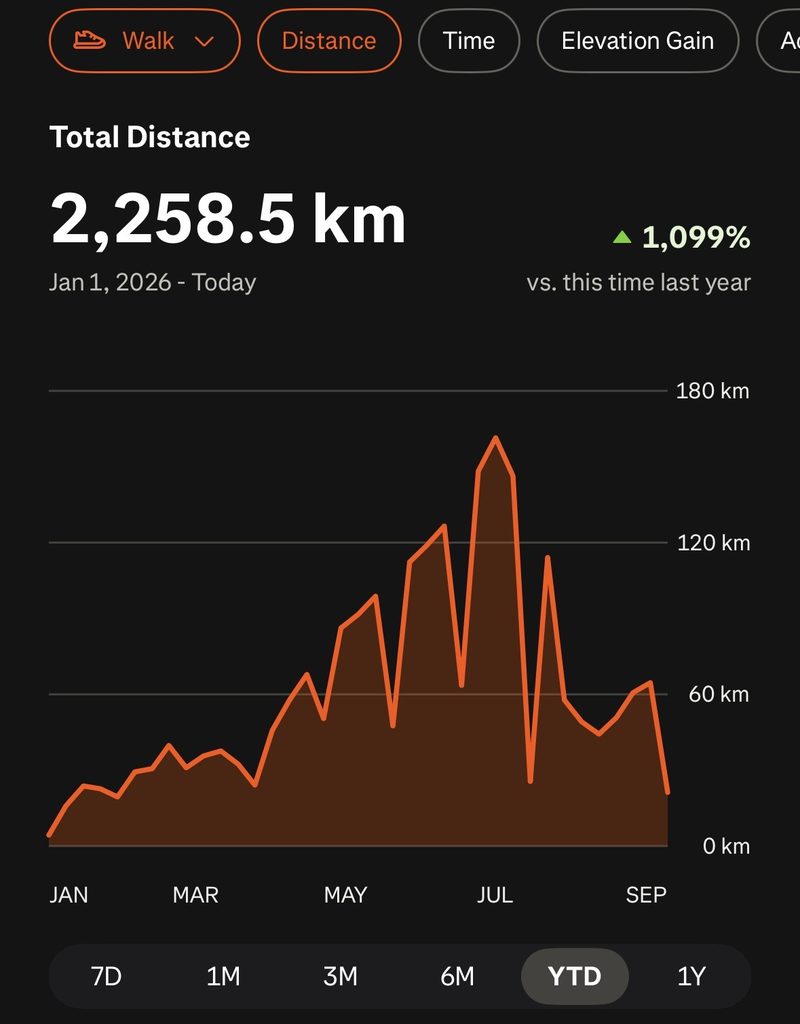
In some athletic circles, images like this are called “chart art.” To others, it just looks like a squiggly line on a graph. This one in particular tracks my accumulated weekly distance. As a previous post noted, I reduced my December kilometre target for a bunch of reasons. This post aims to give you a sense of the effort required to complete the challenge.
Walking seems like such an innocuous activity. Back in the day, a catchphrase to help encourage people to increase activity levels was “Walk a block a day!” Easy enough, right? Yes. The whole campaign was designed to get people moving instead of sitting on the couch. Our bodies are specifically designed and honed for this exact thing. So, what’s the big deal about doing something we are made to do?
For bipedal activities, whether walking, hiking, running, snowshoeing or any other effort involving putting one foot in front of the other, the difficulty increases exponentially as the distance increases. Joints start to ache. You need to carry fuel and hydration. Muscles start asking questions. And, perhaps most insidiously, the mind listens and wants to convince you to stop. In some cases, letting your mind tell you to stop is prudent. It can prevent injuries. The trick of the training is discerning the difference between the mind’s desire for comfort and actual imminent injury. The challenge of long-distance anything is to navigate progressive overload without slipping into the latter territory.
The image above shows how hubris can undo lessons learned. Near the highest peak of the chart, the “load” weeks were progressing based on an equation. The cycle was 3 weeks of progressively increasing distance, followed by one week of “rest” before dialling up the distance again. The rest week still involved lots of movement, but it was 50% of the highest volume week to date. Somewhere along the way, my ego whispered to me that the equation was too easy; that I needed to and could work harder. Instead of adding 2km/day of walking/hiking after the rest week and then 1km/day for each of the remaining two weeks of the load cycle, I decided to go with adding 3km/day the first week, 2km/day the second and 1km/day for the last week. Seemed like a small tweak. It was not. It represented a 50% increase in loading for the cycle.
The silver lining of the wall I hit was the self-reflection it prompted. Why am I feeling completely spent? Why are my moods spiralling down? Why is my body screaming at me to stop? Why, why, why? When I finally silenced my ego, the answers quickly became clear. Loading had been rendered too much, too fast. That seemingly small tweak had put my body, mind and spirit dangerously close to injury. Thankfully, past life lessons let me swallow my pride and course-correct to keep the dream alive.
Now, let’s look at the same chart, but instead tracking time…
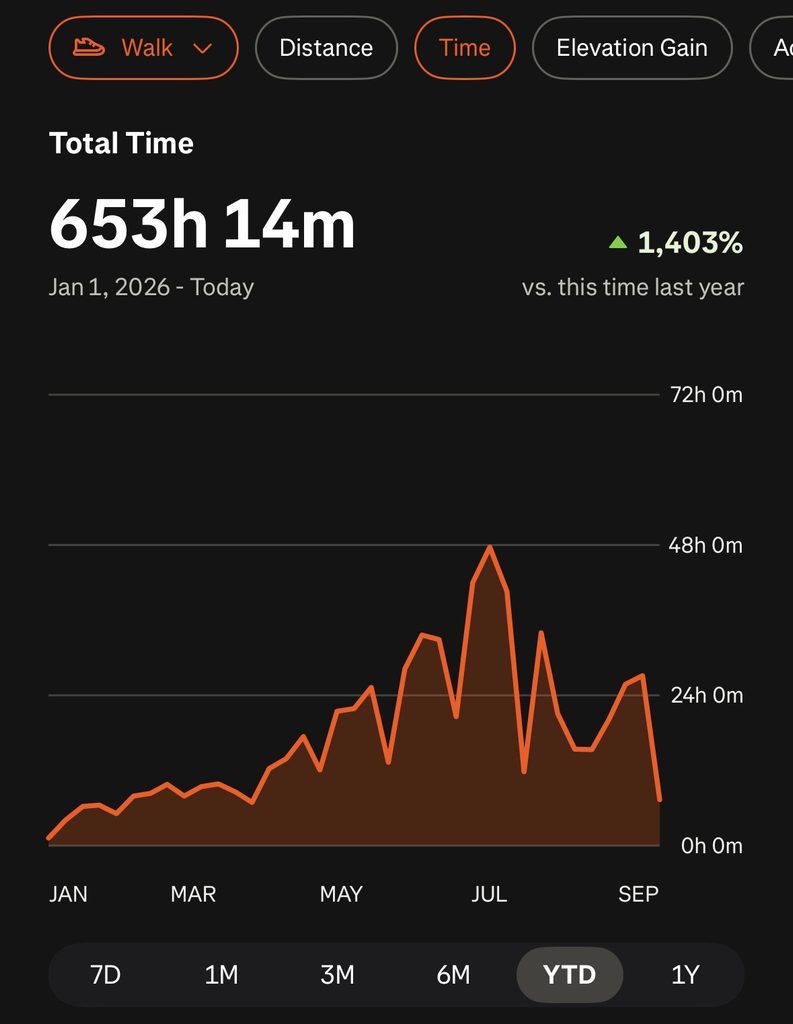
Of particular note here is the time investment. I was literally already putting in “overtime” with training. 48hrs dedicated to training for a charitable endeavour. Layer into the mix that our seasonally affected business was in full swing by this time. On top of that, the additional weight of water and food had dramatically increased. And the temperatures were getting pretty insanely hot as well. The reminder here for me was that my ability to dive deep into achieving a goal often comes with a set of blinders. I was looking at the chart art largely in isolation. The other foundational elements of my life were taking a back seat. I used the word “reminder” because it dawned on me that this predisposition of my character had played a large part in me destroying the life I had worked so hard to build and, ultimately, led to my short time living homeless.
Even when our intentions are good, circumstances and context can lead to undesirable outcomes. I am very grateful to have survived a great many ordeals in my time. Each one taught me something. Sometimes the cycles have repeated many times before the lesson stuck. One of the biggest lessons is that when my heart starts to close, so too does my ability to see the proverbial forest for the trees. Focusing too intensely on anything, by definition, requires shutting out facets of our lives. It may help us achieve goals, but it always comes at a cost. Sometimes, those costs are far greater than the achievement.