
While the finish line has shifted somewhat, the whys of WāōH remain steadfastly intact. The bottom line is that both are of vital importance to the communities they serve and enrich. As I adjust training schedules, business responsibilities, and personal routines, people’s needs persist. Whether one is struggling to rebuild foundations or simply looking for peace, both the Elora Cataract Trailway and East Wellington Community Services play a role each and every day.
A recurring theory that has helped me process and navigate life is Maslow’s Hierarchy of Needs. I am neither a psychology professional nor qualified to argue the veracity of the theory. What I do know is that it helps remind me that life is complex and intertwined with a great many factors both within and beyond my control. It is a bit of a litmus test I use to assess where I am, usually when things feel as though they may be unravelling.
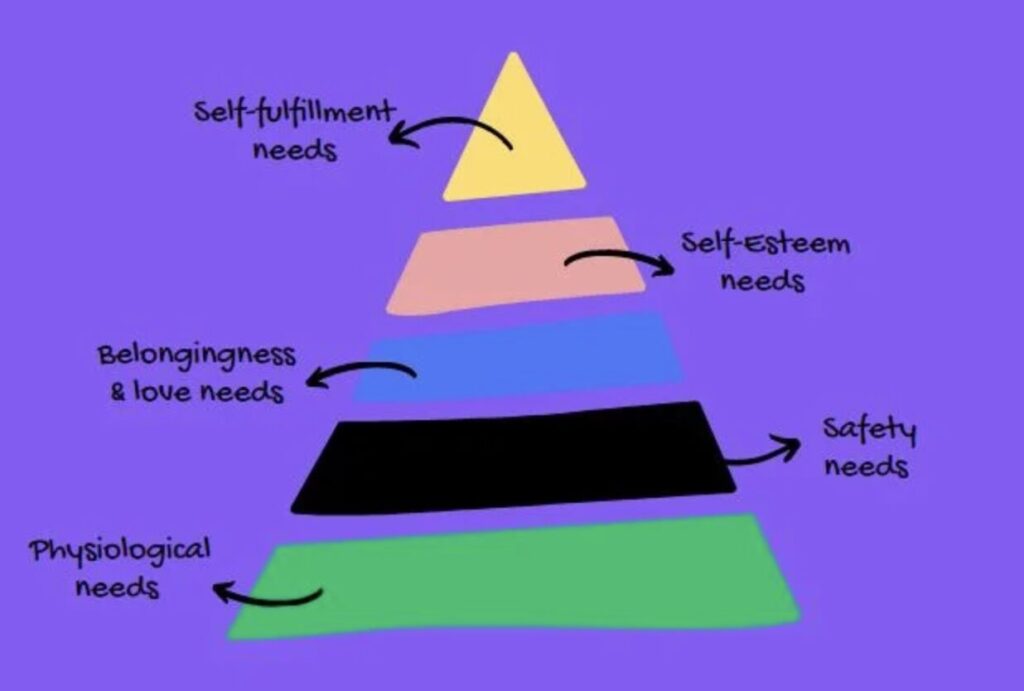
The image above provides a general idea of the concepts Maslow incorporated into his theory. The idea is fairly simple. There are groups of “needs” we must all satisfy in order to rise higher on the pyramid. My interpretation is that the more solidly built each level, the better the chances one will continue to rise/remain at higher levels of being. Of course, there are times when the layers can be shaken or even erased by events completely beyond our control. Take, for example, a tornado ripping through one’s house. Many, if not all, layers could be wiped out in seconds or minutes. What we are hopefully left with is the accumulated knowledge of the building process we had undertaken before the tornado struck. This could allow us to quickly reconstruct our pyramid. I say “could” because sometimes the trauma of certain events wipes the slate clean. In those cases, we could also be left with despair-induced paralysis that keeps us from moving in any direction but down.
I view ECTA and EWCS as a matrix-style meta scaffolding in which everyone in the community can be helped on their journey to the top of their pyramid. In other words, assets like the Elora Cataract Trailway provide a “free” space for anybody to exercise, relax, commune with nature and generally recharge the soul or spirit. The benefits of getting outside and amongst nature are well-documented. In this way, we could look at the trailway as a kind of bedrock on which we can place our pyramid. We’ll call this the “x” axis. EWCS could then be viewed as the “y” axis, positioned vertically alongside the pyramid. They assess people’s needs and seek to support their well-being and growth through available programs and services. Without those axes to aid people on their journey, the ability to rebuild or, in some cases, to start a solid foundation is diminished. Two vital and necessary organizations that help people each and every day
Now, what I have just described two-dimensional application of the theory. Still valid in my mind, but the existence of these worthy organizations is always at risk since they largely rely on altruistic funding. This is where I see WāōH entering the picture on the “z” axis. The goal is to help them help others. The hope is that my effort and sacrifices, even scaled back, will raise awareness and funds to keep them moving forward toward their respective goals.
Soon, there will be links through which you can show financial support with donations. Stay tuned!